Your California Realtor Career Journey Starts at our Real Estate School
A realtor school in California is a state-approved educational institution that specifically prepares you to become a licensed real estate agent. If you choose, you can join a local REALTOR® association and become a REALTOR®—a member of the National Association of REALTORS® (NAR).
The California Department of Real Estate (DRE) is the state agency responsible for licensing and regulating real estate professionals in California. The DRE ensures that all real estate agents and brokers meet educational and ethical standards to protect consumers and maintain industry integrity.
A realtor school’s primary goal is to help you pass the DRE licensing exam and launch your career as a real estate agent in California. Once licensed, you may choose to join the NAR and become a REALTOR®, which provides additional professional benefits and requires adherence to a strict code of ethics.
With California’s dynamic and competitive real estate market, 2026 offers a prime opportunity to enter the industry equipped with the latest knowledge and skills.
California realtor schools provide comprehensive pre-licensing courses covering property law, contracts, agency relationships, and state-specific regulations. Along with exam prep tools designed to mirror the California Department of Real Estate (DRE) licensing exam, many programs include business skills, technology training, and continuing education foundations to keep your license active and your career thriving.
This guide is for you if you are:
A career changer in your 30s or 40s seeking a flexible, income-driven profession in California
A recent college grad exploring options that don’t require a graduate degree
A parent returning to work who needs a self-paced schedule
A part-timer testing the waters before committing full-time
Whether you’re comparing course packages online or mapping out your first year’s income in California, this guide offers concrete steps—not vague advice—to help you move forward with confidence.
Choosing the Right California Realtor School
Selecting the right realtor school is the first step toward your California real estate career. The California Department of Real Estate (DRE) maintains a list of approved schools that meet state educational requirements. Before enrolling, confirm the school holds current DRE approval, as completing an unapproved course means your hours won’t count toward your California license.

State Approval and Accreditation
When evaluating schools, consider the following criteria:
State approval status: Look for a clearly displayed DRE approval number or certificate on the school’s website.
Exam pass rates: Schools with pass rates above the state average (typically around 50–70%) demonstrate effective instruction.
Years in operation: Schools with 10+ years often have refined curricula and experienced real estate professionals teaching the material.
Live support: Access to phone, chat, or email support with response times under 24 hours on weekdays.
Recent student reviews: Look for reviews dated within the last 12–18 months to ensure feedback reflects current course quality.
Pre-Licensing Hour Requirements
California requires:
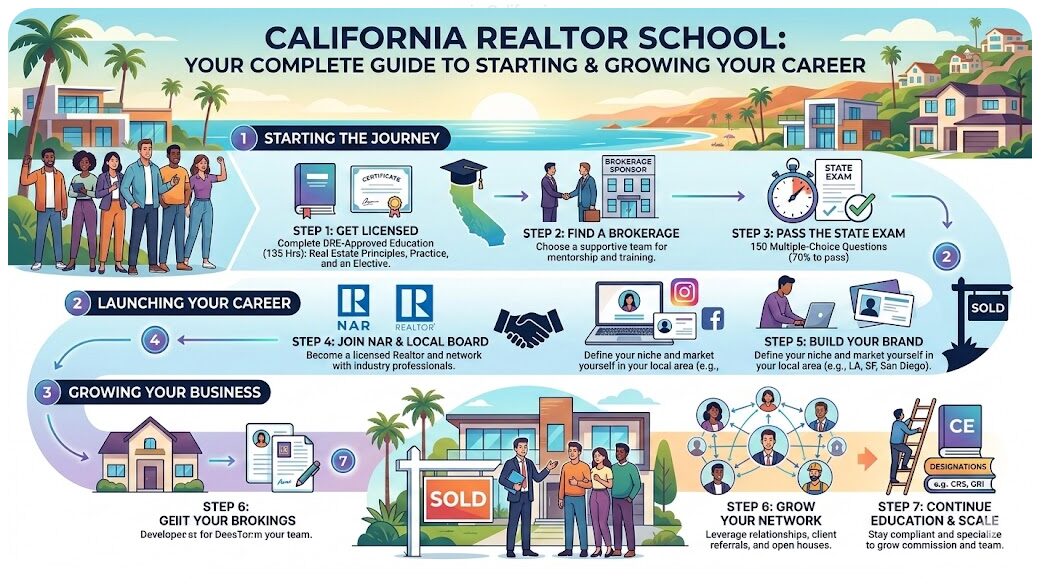
135 hours total, divided into three 45-hour courses:
Real Estate Principles
Real Estate Practice
One elective course approved by the DRE
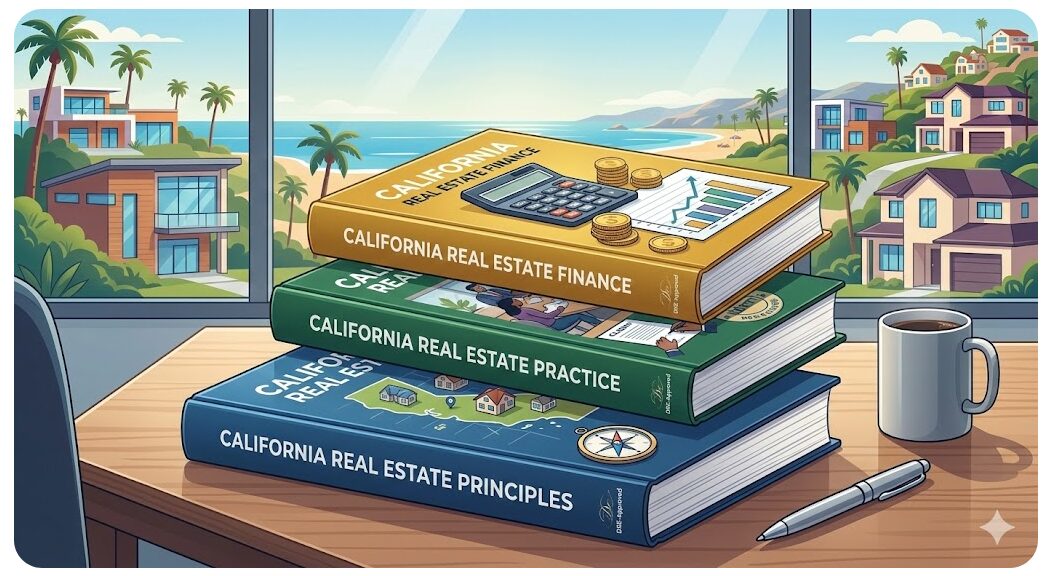
A trusted California real estate school clearly displays these requirements upfront so you know exactly what you’re committing to before purchase.
Evaluating Course Formats
Here’s a comparison of the main course formats available in California:
Format | Description | Best For | Typical Completion Time |
|---|---|---|---|
Fully self-paced online | Complete lessons on your own schedule. | Working parents, night-shift employees | 8–12 weeks |
Live online (livestream) | Structured Zoom-style sessions with set class times. | Learners needing accountability, interaction | Varies by schedule |
In-person classroom | Traditional setting with fixed schedules. | Students preferring face-to-face instruction | Varies by schedule |
Once you’ve selected a school, the next step is understanding the licensing process and how to move from enrollment to becoming a licensed California real estate agent.
From Enrollment to California Real Estate License: How a Realtor School Works
The path from enrollment to becoming a licensed California real estate agent follows a predictable sequence. Below, each stage is broken down for clarity.
Eligibility Requirements
To begin, you must:
Be at least 18 years old.
Hold a high school diploma or GED equivalent.
Enrollment Process
Follow these steps to enroll:
Choose a DRE-approved pre-licensing course.
Confirm the school is certified by the California Department of Real Estate.
Course Completion
To complete your education:
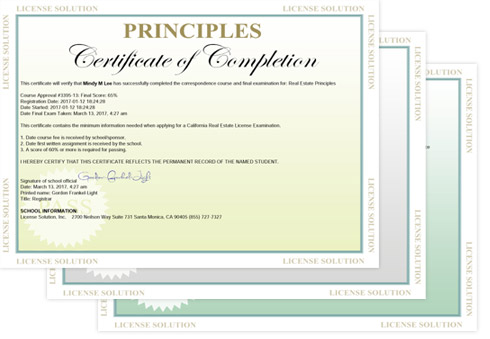
Finish all required 135 hours and unit quizzes.
Track your progress; most online platforms save your place automatically.
Pass the school’s final exam if required by the school.
Exam Scheduling
After coursework:
Schedule your California state exam through the DRE’s designated vendor, PSI.
Post-Exam Steps
Once you pass the state exam:
Find a sponsoring broker.
Obtain errors and omissions (E&O) insurance to activate your license.
Realistic time frames for California pre-licensing:
Full-time study (10–15 hours/week): approximately 8–10 weeks to complete all three pre-licensing courses consecutively, considering each course requires a minimum of 18 days.
Part-time study (5 hours/week): 3–6 months to complete pre-licensing.
Add 10–14 days of focused exam prep after finishing coursework.
With your roadmap in place, the next step is to understand the content and structure of the pre-licensing courses themselves.
Pre‑Licensing Courses: The Foundation of California Realtor School
California’s pre-licensing education consists of three 45-hour courses:
Real Estate Principles: Covers fundamentals of property ownership, contracts, agency, financing, appraisal, and California-specific laws.
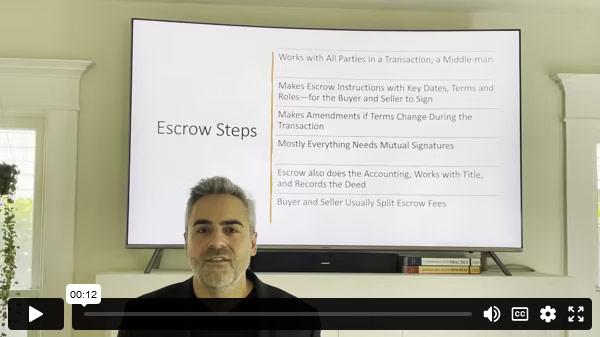
Real Estate Practice: Focuses on practical application, including listing agreements, disclosures, escrow, and property management.
Elective Course: Choose from options like Real Estate Finance, Legal Aspects, Property Management, or Mortgage Loan Brokering.
Course delivery in California should include:
Short video lessons on discrete topics
Reading modules with downloadable study guides
Interactive quizzes after each unit
End-of-unit practice exams mirroring the California real estate exam format provided by a trusted real estate school to ensure a comprehensive real estate education experience.
Once you’ve completed your coursework, the next challenge is preparing for and passing the California real estate exam.
California Real Estate Exam Prep: Turning Knowledge into a Passing Score
Exam prep for California licensing emphasizes understanding the DRE’s exam format and content, including California-specific laws and regulations.
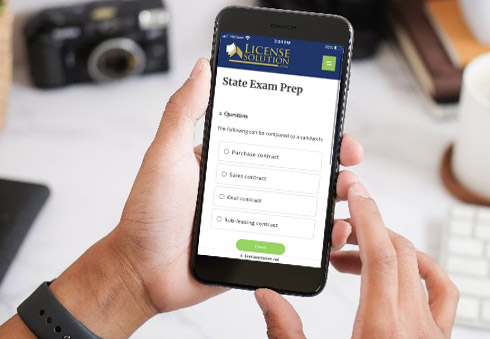
Strong California realtor school exam prep includes: Tips and tricks for passing the California real estate practice exam
Timed practice exams simulating the 150-question California state exam
Topic-specific quizzes on agency, contracts, math, ethics, and fair housing
Detailed answer rationales explaining California laws and concepts
Interface mirroring PSI’s testing software
Recommended study timeline for California:
Dedicate 10–14 days of focused exam prep after coursework
Take 2–3 full practice exams under timed conditions
Aim for consistent scores of 80–85% on practice tests before booking your real exam
After passing your exam, you’ll need to maintain your license through continuing education and post-licensing requirements.
Continuing Education & Post‑Licensing in California
California requires 45 hours of continuing education every four years to renew your license, including courses on ethics, agency, trust fund handling, fair housing, and risk management.
California CE features to look for:
100% online, self-paced modules available anytime
Automatic reporting to the California DRE where allowed
License renewal reminders via email messages or text
Comprehensive course packages tailored for California agents
With your license maintained, you’ll gain more than just legal credentials—realtor school also equips you with practical business and communication skills.
What You Really Learn in California Realtor School (Beyond the License)
California realtor school prepares you for more than the exam. You develop skills in negotiation, pricing, client communication, and technology tools widely used in California’s real estate market.
Skill categories emphasized in California:
Negotiation tactics tailored to California’s competitive markets
Pricing strategies using MLS (Multiple Listing Service) data and local market trends
Real estate math including California-specific commission splits and closing costs
Client communication frameworks for California buyers and sellers
Technology proficiency with popular CRM (Customer Relationship Management) and e-signature tools used statewide
Market analysis focusing on California’s diverse regions and regulatory environment
As you build your skills, planning your business and income is the next logical step.
Business and Income Planning for California Realtors
California agents often face higher costs of doing business. Realtor schools include business planning to help you set realistic income goals and manage expenses.

Planning elements for California agents:
12-month income goal based on local median home prices
Average commission per transaction reflecting California’s typical 2.5–3% rates
Closing projections adjusted for California’s market dynamics
With a business plan in place, it’s essential to understand the ethical and legal standards that govern your practice.
Ethics, Fair Housing, and Professionalism in California
California realtor schools emphasize compliance with the National Association of REALTORS® (NAR) Code of Ethics and California’s Fair Employment and Housing Act (FEHA), which extends protections beyond federal laws.
Key California laws and codes:
California Fair Employment and Housing Act (FEHA)
NAR (National Association of REALTORS®) Code of Ethics
California Bureau of Real Estate regulations
Example situations:
Avoiding steering or discrimination in California’s diverse communities
Proper advertising language compliant with California law
Understanding your ethical obligations, you can now choose the learning format that best fits your lifestyle.
Online vs. In‑Person California Realtor School: Which Format Fits You?
Most California students choose online real estate school for flexibility, but in-person and livestream options remain popular.
Format | Learn Anytime? | Real-Time Interaction? | Best For | Typical Completion Time |
|---|---|---|---|---|
Fully online self-paced | Yes | No | Working parents, flexible pacing | 2 months full-time, 3-4 months part-time |
Live online (Zoom) | No | Yes | Accountability | Varies by schedule |
In-person classroom | No | Yes | Face-to-face instruction | Varies by schedule |
After choosing your format, consider the support and student experience offered by your chosen school.
Support and Student Experience in California Realtor School
California schools should offer robust support, including:
Email and phone support with fast response times
Technical help for online platforms
Email messages with study tips, deadlines, and updates
With support in place, it’s important to understand the costs, financing options, and potential return on investment.
Costs, Financing Options, and Return on Investment in California
California pre-licensing plus exam prep typically costs $100–$350. Additional fees include the state exam ($100), fingerprinting ($49), and license application ($350).
Typical California costs:
Pre-licensing courses: $100–$350
Exam prep add-on: $50–$150
State exam fee: $100
Fingerprint/background check: $49
License application fee: $350
Local REALTOR® dues and MLS fees vary by region (if you wish to become a REALTOR®)
ROI example for California:
Total upfront investment: ~$700–$2,500
Conservative first-year net income: $20,000–$40,000 part-time
Breakeven after 1–3 transactions
Most California students study part-time while working. Setting a consistent schedule and using self-paced online courses helps balance commitments.
With your investment and schedule planned, you’re ready to launch your real estate career.
Key Takeaways for California
Choose a DRE-approved realtor school with strong pass rates and support.
Complete 135 hours of pre-licensing education in three courses.
Pass the California state exam and launch your career with a sponsoring broker.
Invest in continuing education to maintain your license and grow your skills.
Use self-paced online courses and other flexible formats to fit your lifestyle.
Launching Your California Real Estate Career
After licensing, take these steps:
Complete MLS onboarding
Join local associations like CAR (California Association of REALTORS®) or NAR (National Association of REALTORS®)
Set up business systems tailored to the California market
As your career progresses, you may want to pursue advanced specializations and designations.
Continuing Growth: Specializations and Advanced Designations in California
California agents may specialize in luxury homes, first-time buyers, commercial real estate, or property management. Designations like ABR (Accredited Buyer’s Representative), CRS (Certified Residential Specialist), and SRS (Seller Representative Specialist) are recognized statewide and can help you stand out in the market.
Your path to success in California real estate starts with the right education and a clear plan. Begin your journey today at a trusted California realtor school.
Glossary of Acronyms and Designations
DRE: California Department of Real Estate – the state agency that licenses and regulates real estate professionals.
NAR: National Association of REALTORS® – the largest trade association for real estate professionals in the U.S.
CAR: California Association of REALTORS® – the state-level association for REALTORS® in California.
MLS: Multiple Listing Service – a database used by real estate professionals to share property listings.
CRM: Customer Relationship Management – software for managing client relationships.
ABR: Accredited Buyer’s Representative – a designation for agents specializing in representing buyers.
CRS: Certified Residential Specialist – a designation for agents with advanced training in residential sales.
SRS: Seller Representative Specialist – a designation for agents specializing in representing sellers.
FEHA: Fair Employment and Housing Act – California law prohibiting discrimination in housing and employment.